

Why Are Mountains so Important in the Bible?
Bible Study

Audio By Carbonatix
By Annette Griffin, Crosswalk.com
Scripture is full of magnificent views of nature—from rushing rivers to still waters; from towering deep-rooted trees to sprawling, fruit-bearing vines. Rough-hewn stones, starry hosts, lush gardens, caves, valleys, thunder, rain, and lightning—they all have a story to tell within the narrative of Scripture. But none more so than the mountains in the Bible.
“Come, let us go up to the mountain[s] of the Lord, to the temple of the God of Jacob. He will teach us his ways, so that we may walk in his paths” (Micah 4:2).
What Do Mountains Symbolize?
Throughout the ages, people of all races and religions have associated mountaintops with heightened spirituality. And why not? Since ancient times, many have understood the cosmos as a three-part structure consisting of the heavens, the earth, and the dark spiritual places beneath the earth. So it makes sense that humans would attempt to draw closer to their gods by building temples, altars, and shrines on the highest peaks.
Since the Bible gives us multiple indicators that Heaven is a locale where the One True Living God “dwells” (Isaiah 66:1, Matthew 6:9, 1 Peter 3:22) it also seems natural, according to human logic, that Christians might attempt to draw closer to God by scaling mountains.
However, the Bible makes it clear that God’s purpose for creating mountain ranges has nothing to do with drawing humanity closer to Himself in physical proximity—but the symbolism behind these majestic-peaked formations do have the potential to draw our hearts closer to His.
Just like every other element in creation ultimately reveals the nature of its Creator—mountains divulge important information about who God is. In scripture we see this symbolism played out in over 500 verses and hundreds of events, involving 35 major mountain ranges.
7 Important Mountains in the Bible?
From Genesis to Revelation mountains play a significant role in the unfolding redemptive plan of our Creator. The events that occur on each of these mountains affirm God’s faithfulness, His sovereignty, and His all-surpassing power. But perhaps most vividly, these events reveal the stability and magnitude of God’s covenant-keeping power.
Mount Ararat (Genesis 8:4): This mountainous area is widely recognized as the resting place of Noah’s Ark. After 150 days of surviving storm surges, wildlife drama, and epic flooding “the ark came to rest on the mountains of Ararat.” It would still be 40 days before Noah dared to open a window (Genesis 8:6), but by God’s grace, they were finally back on solid ground.
After Noah and his family emerged from the ark and stood upon Mount Ararat, God gave them an everlasting promise. “I establish my covenant with you: Never again will all life be destroyed by the waters of a flood; never again will there be a flood to destroy the earth” (Genesis 9:11).
Mount Sinai/Mount Horeb (Exodus 19 and 20, Numbers 3, Nehemiah 9:13,14): This mountain, called by two different names, is where “God made a covenant with the Israelite people,” says Amanda Idleman in What Is the Significance of Mount Sinai in the Bible? It’s the place where Moses first encountered God in the burning bush, then later met with Him to receive the 10 Commandments. The liberated Israelites first heard God’s voice from this mountain, but they were so traumatized by God’s power and holiness that they didn’t dare approach or touch Mount Sinai for fear they would be destroyed. This mountain represents the Old Covenant law—which set boundaries for God’s chosen people that would expose their sinful nature and pave the way for a better covenant yet to come.
Mount Nebo/ Mt. Pisgah (Deuteronomy 32:49, 34:1): Moses finally got to see the land flowing with milk and honey when he “climbed Mount Nebo from the plains of Moab to the top of Pisgah, across from Jericho. There the LORD showed him the whole land.” Moses’s 40 years of desert wandering had finally come to an end on that peak, where he was ultimately buried. Even though Moses wasn’t permitted to experience the rich and fertile land promised by God to the Israelites—the true Promised Land awaited the faithful leader after his death.
Mount Carmel (1 Kings 18:16-46, 2 Kings 2:25): This is the mountain where God showed His supremacy among the pagan people and literally destroyed their false gods. God’s chosen man, Elijah challenged the wicked King Ahab and prophets of Baal to a showdown on this mountain and watched as God proved Himself the victor using fire and rain.
Even though The Israelites had rejected God’s covenant, torn down His altars, and put His prophets to death with the sword (1 Kings 19:14). God delivered them from King Ahab and promised to “reserve seven thousand in Israel—all whose knees had not bowed down to Baal.”
In Elijah and the Miracle of Fire from Heaven, Bianca Juárez Olthoff reminds us of another powerful takeaway from this mountaintop event. “In the moment of waiting for the miracle, Elijah repaired the broken altar and called the people by name, ‘Your name shall be Israel’…the enemy knows our name but calls us by our sin; God knows our sin but calls us by our name. Sometimes a reminder of who we are is stronger than a rebuke of what we are not.”
Mount Moriah/Mount Zion (Genesis 22:2, 2 Chronicles 3:1, 2 Samuel 5:1-10, 1 Kings 8:1): Upon this hilly range of sacred land, Scripture shows God’s redemptive work at Mount Moriah even before the mountain was rebranded Mount Zion. There, Abraham agreed to do the unthinkable; he bound his son and prepared to sacrifice him, having faith that God would keep His promise and, “provide Himself a lamb for a burnt offering.” On this mountain Jacob climbed to Heaven, David purchased the threshing floor of Ornan, and Solomon built the magnificent temple of the Lord.
The divinely orchestrated victories on Mount Moriah were just a warmup and foreshadowing of miraculous events to come. After the first temple was built, the whole area including the mountain range became known as Zion. Not only did the hill gain a new title, but it also inherited a much larger identity based on a Davidic covenant that would transform this temporal mountain into an eternal city. The new covenant would be laid on the foundation of Zion—through Jesus Christ our Lord.
Mount of Olives (Luke 19:29-37, Luke 22:39, Acts 1:9-12, 2 Samuel 15:30): This mountain is the home to many tragic events. In the Old Testament David used it as a refuge when his son Absalom rebelled. Later, King Solomon used it for idol worship. In the New Testament Jesus wept over Jerusalem there. And The Garden of Gethsemane, located on the western slope of the Mount of Olives, is where Jesus agonized alone in prayer before His crucifixion—shortly before Judas betrayed Him.
But out of the ashes of these great tragedies, God offers hope and promise to His people. This is the same mountain where Jesus delivers His Olivet Discourse, which foretells a time when all will be made right. After His resurrection, Jesus once again stands on the Mount of Olives, blesses His disciples, and is taken to Heaven before their eyes. Immediately following his ascension, angels appear and tell the disciples, “This same Jesus, who has been taken from you into heaven, will come back in the same way you have seen him go into heaven.” The disciples believe the promise and know Jesus will not only return, but He will one day return to that same spot on the Mount of Olives—according to the prophet Zechariah (Zechariah 14:4).
Mount Hermon (Matthew 17:1-9): Upon this mountain, the tallest in the region, Jesus took Peter, James, and John to pray. There—on the Mount of Transfiguration—Jesus revealed His glory. “His face shone like the sun, and his clothes became as white as the light [and] there appeared before them Moses and Elijah, talking with Jesus.”
The name of the “high mountain” where the transfiguration took place is not specified in the New Testament. Scholars debate whether Mount Tabor or Mount Hermon is the mountain in question, but many believe Mount Hermon fits better with Matthew’s description and the biblical events that occurred before and after the transfiguration. Plus, according to Jewish historians, Mount Tabor was the site of a Roman military camp during Jesus’s time on earth, which would have made the mountain an unlikely setting for Jesus and his disciples to be alone.
More important than the actual location of this mountain is the significance of the event that happened upon it. Not only did the disciples gain a greater understanding of Jesus’s deity through the transfiguration, but when the Father commands the disciples to, “Listen to Him!” (instead of lumping Jesus together with Moses and Elijah). God reveals Jesus as the fulfiller of the Old Covenant and the embodiment of the new!
Does the Bible Describe Mountains in a Symbolic Way?
Throughout Scripture, we find Bible Verses About Mountains used as symbolic elements to describe steadfastness, trustworthiness, immovability, strength, and faith.
In Hebrews 12, we find a fascinating passage that uses two specific mountains as symbolism and a summary of God’s covenant plan. The author of the letter—which many believe is Paul—is speaking to new Jewish Christians, to exhort them to persevere in the face of persecution.
Referring to Mount Sinai, where the law of the Old Covenant was formed, the writer reminds the new converts that they have not, “come to a mountain that can be touched and that is burning with fire; to darkness, gloom and storm; to a trumpet blast or to such a voice speaking words that those who heard it begged that no further word be spoken to them.”
The writer encourages the new converts that they have instead “come to Mount Zion, to the city of the living God, the heavenly Jerusalem [where] thousands upon thousands of angels in joyful assembly … and to Jesus the mediator of a new covenant, and to the sprinkled blood that speaks a better word than the blood of Abel.”
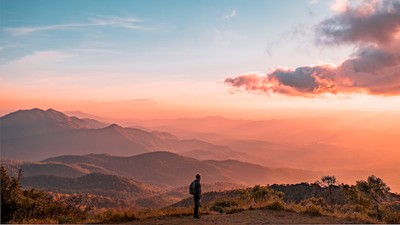
Photo credit: Unsplash Photo by Colton Duke
Annette Marie Griffin is an award-winning author who writes timeless pieces that help wanderers find home. She’s a columnist for StarLight Magazine for kids, and she teaches writing workshops at local and national conferences. When Annette isn’t writing, teaching, or speaking she enjoys making memories with her brilliant husband, three adult children, two teens, and four adorable grands.
